
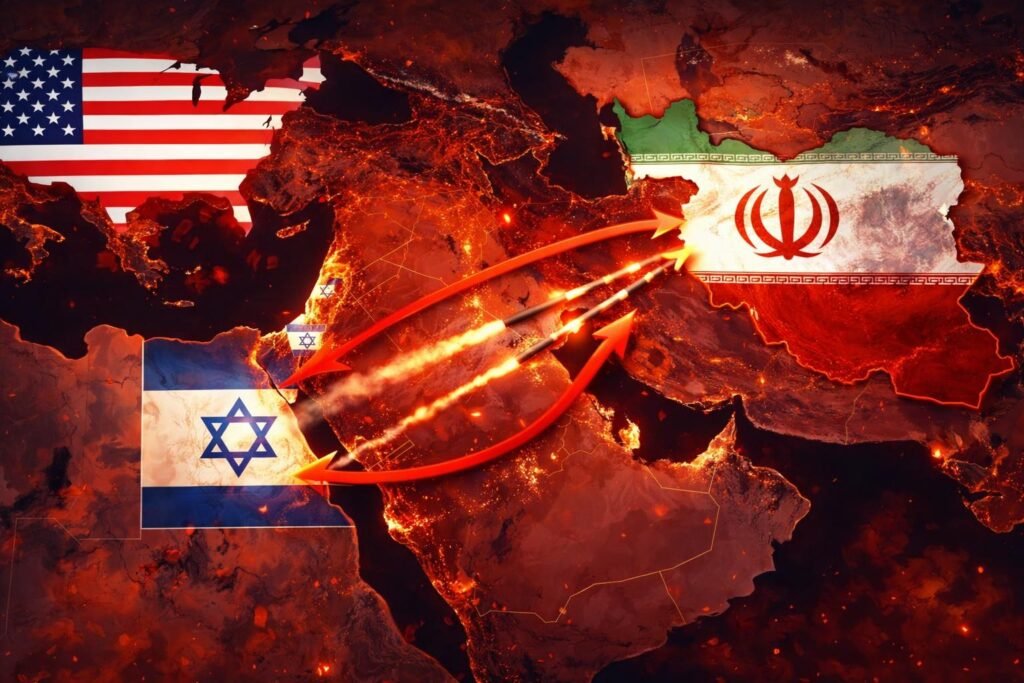
Iran – USA War 2026: Latest Updates, Causes, and Global Impact of the Growing Middle East Conflict
Introduction
The Middle East is once again at the center of global attention as a major war involving Iran, Israel, and the United States has erupted in 2026. What began as targeted military strikes has quickly escalated into a regional conflict involving multiple countries, militias, and geopolitical alliances. Airstrikes, missile attacks, drone warfare, and cyber operations have already caused thousands of casualties and severe disruptions across the region.
The war officially began on February 28, 2026, when the United States and Israel launched coordinated attacks on Iranian military and nuclear infrastructure in what they described as a pre-emptive operation to neutralize threats posed by Iran’s military and nuclear programs.
Within days, Iran retaliated with missile and drone attacks on Israeli territory, U.S. bases, and allied countries in the Gulf. The conflict has since spread beyond Iran and Israel to neighboring countries including Lebanon, Iraq, and parts of the Persian Gulf.
This article examines the latest developments, why the war began, how it escalated, the key players involved, and what it could mean for the future of global geopolitics.

Latest News and Developments in the Iran War
The conflict has rapidly intensified since its outbreak, with heavy airstrikes and retaliatory attacks occurring almost daily.
Recent reports indicate that Tehran and other Iranian cities have been heavily bombed, with military facilities, infrastructure, and government targets hit during ongoing air campaigns.
Iran has responded by launching missile strikes against Israel and U.S. military installations in the Middle East. Some of these attacks reportedly targeted U.S. facilities in Gulf countries and embassies in the region.
According to international reports:
More than 1,200 people have been killed in Iran due to the strikes.
Iranian retaliatory attacks have targeted Israel, U.S. bases, and neighboring countries.
Fighting has spread to Lebanon and Iraq, where Iran-backed militias are launching attacks against Western targets.
Several countries are evacuating their citizens from the region due to escalating violence.
The conflict has also caused major disruptions to air travel across the Middle East, prompting countries such as the United Arab Emirates to open emergency air corridors to manage stranded passengers and aircraft.
Global leaders and the United Nations have warned that the war could spiral into a wider regional or even global conflict if diplomatic solutions are not found quickly.
How the War Started
The war traces back to long-standing tensions between Iran, Israel, and the United States, which have existed for decades.
However, the immediate trigger came when the U.S. and Israel launched a large-scale coordinated strike on Iran on February 28, 2026.
The operation targeted:
Iranian nuclear facilities
Military bases
Revolutionary Guard installations
Key government leaders
Reports also indicate that the strikes killed several high-ranking Iranian officials and senior military commanders. Some sources say that Iran’s Supreme Leader Ayatollah Ali Khamenei was killed during the initial attacks, dramatically escalating the conflict.
Iran responded by launching Operation True Promise IV, which included missile strikes, drone attacks, and mobilization of allied militias across the Middle East.
This exchange of attacks quickly pushed the region into full-scale war.
The Long History Behind the Conflict
To understand why this war happened, it is important to examine the deeper historical tensions that have shaped relations between Iran, Israel, and the United States.
1. The Iran–U.S. Rivalry
The hostility between Iran and the United States dates back to the 1979 Iranian Revolution, when the U.S.-backed Shah of Iran was overthrown and replaced by an Islamic government.
Following the revolution:
Iran became openly anti-American
The U.S. imposed sanctions on Iran
Diplomatic relations collapsed
Over the years, tensions escalated due to nuclear development, regional influence, and support for militant groups.
2. Iran–Israel Conflict
Iran and Israel have been enemies for decades.
Iran’s government has repeatedly criticized Israel’s policies toward Palestinians and supports armed groups opposed to Israel.
Iran has provided support to several groups including:
Hezbollah in Lebanon
Hamas in Gaza
Militias in Iraq and Syria
Israel views Iran as its greatest security threat, especially due to Iran’s nuclear program and missile development.
3. Iran’s Nuclear Program
One of the biggest sources of tension has been Iran’s nuclear program.
Western governments have long accused Iran of trying to build nuclear weapons, while Iran insists its program is for peaceful energy purposes.
Over the past two decades:
International sanctions were imposed on Iran
Nuclear negotiations took place
The 2015 Iran nuclear deal attempted to limit Iran’s nuclear activities
However, the deal collapsed after the United States withdrew from it, leading to renewed tensions.
Immediate Causes of the 2026 War
Several key developments in recent years contributed to the outbreak of the current war.
1. Growing Israeli Concerns
Israel had repeatedly warned that Iran was approaching the capability to build nuclear weapons.
Israeli leaders argued that allowing Iran to acquire nuclear weapons would threaten Israel’s existence.
This fear pushed Israel to consider military action.
2. Rising Regional Proxy Conflicts
Iran has built a network of allied groups across the Middle East.
These include:
Hezbollah in Lebanon
Militias in Iraq and Syria
Houthi forces in Yemen
These groups have frequently clashed with Israeli and U.S. forces.
3. Direct Attacks and Escalation
In the months leading up to the war:
Missile attacks increased
Cyber attacks escalated
Military confrontations intensified
The U.S. and Israel eventually concluded that a pre-emptive strike was necessary.
Key Players in the War
The war is not limited to Iran and Israel alone. Several other countries and groups are involved.
1. Iran
Iran is the central actor in the conflict.
The country’s military forces include:
The Iranian Armed Forces
The Islamic Revolutionary Guard Corps (IRGC)
Iran is also supported by regional militias.
2. Israel
Israel has played a major role in launching the initial strikes.
Its military capabilities include:
Advanced air force operations
Missile defense systems
Intelligence networks
Israel’s objective appears to be weakening Iran’s military and nuclear infrastructure.
3. United States
The United States joined Israel in launching attacks on Iran.
Washington claims the operation was necessary to protect regional stability and prevent nuclear proliferation.
The U.S. military has deployed:
Fighter jets
Bombers
Naval forces in the Persian Gulf
4. Iran-Backed Militias
Iran’s allies across the Middle East have also joined the conflict.
These include:
Hezbollah in Lebanon
Militias in Iraq
Various pro-Iran groups across the region
These forces are attacking Israeli and U.S. targets.
5. Other Global Powers
Several global powers are closely watching the conflict.
Reports suggest that Russia may have provided intelligence support to Iran during the conflict.
Meanwhile, Western countries are largely supporting Israel and the United States.
How the War is Being Fought
The Iran war is being fought using multiple forms of modern warfare.
1. Airstrikes
Airstrikes have been the primary military tactic used by the United States and Israel.
Targets include:
Military bases
Weapons factories
Nuclear facilities
Missile launch sites
2. Missile Warfare
Iran has retaliated with missile strikes targeting:
Israeli cities
U.S. military bases
Strategic infrastructure
Some of these attacks have reached neighboring countries.
3. Drone Warfare
Both sides are heavily using drones.
Drones are used for:
Surveillance
Target identification
Precision strikes
4. Cyber Warfare
Cyber attacks have also become part of the conflict.
These attacks target:
Government networks
Financial systems
Military communications
Humanitarian Impact
The war has already caused significant humanitarian consequences.
Thousands of people have been killed or injured.
Major cities have suffered damage, and millions of civilians face uncertainty and displacement.
Neighboring countries are preparing for refugee flows as people flee the conflict zones.
Economic Consequences
The war has major global economic implications.
1. Rising Oil Prices
Iran is a key player in global energy markets.
Disruptions in the Persian Gulf have already pushed oil prices higher.
Reports suggest prices have climbed above $90 per barrel amid fears of supply disruptions.
2. Threat to Global Shipping
The Strait of Hormuz is one of the most important shipping routes in the world.
Any conflict in this region threatens global energy supply chains.
3. Global Market Instability
Stock markets around the world have reacted to the uncertainty caused by the conflict.
Investors are concerned about the possibility of a broader war.
International Reaction
The global reaction to the war has been mixed.
Western Countries
Many Western countries have supported Israel and the United States.
However, some leaders have expressed concerns about escalation.
United Nations
The United Nations has called for an immediate ceasefire and warned about the humanitarian crisis.
Middle Eastern Countries
Countries in the Middle East are deeply concerned.
Some governments fear the conflict could destabilize the entire region.
Possible Future Scenarios
Experts believe several outcomes are possible.
Scenario 1: Limited War
The conflict could remain limited to Iran and Israel, with occasional regional involvement.
Scenario 2: Regional War
More countries and militias could join the conflict, expanding it across the Middle East.
Scenario 3: Diplomatic Settlement
International diplomacy could eventually lead to ceasefire negotiations.
Scenario 4: Regime Change in Iran
Some analysts believe the war may aim to weaken or replace Iran’s current government.
Conclusion
The Iran war of 2026 represents one of the most serious geopolitical crises in recent years. What began as targeted military strikes has quickly evolved into a complex regional conflict involving multiple countries and armed groups.
With ongoing airstrikes, missile attacks, and escalating military operations, the situation remains extremely volatile.
The outcome of the war will not only shape the future of Iran and the Middle East but could also have lasting consequences for global politics, energy markets, and international security.
For now, the world watches closely as diplomats, military leaders, and governments attempt to navigate one of the most dangerous conflicts of the modern era.